2026 Oscar Review: 'One Battle After Another'
March 10, 2026
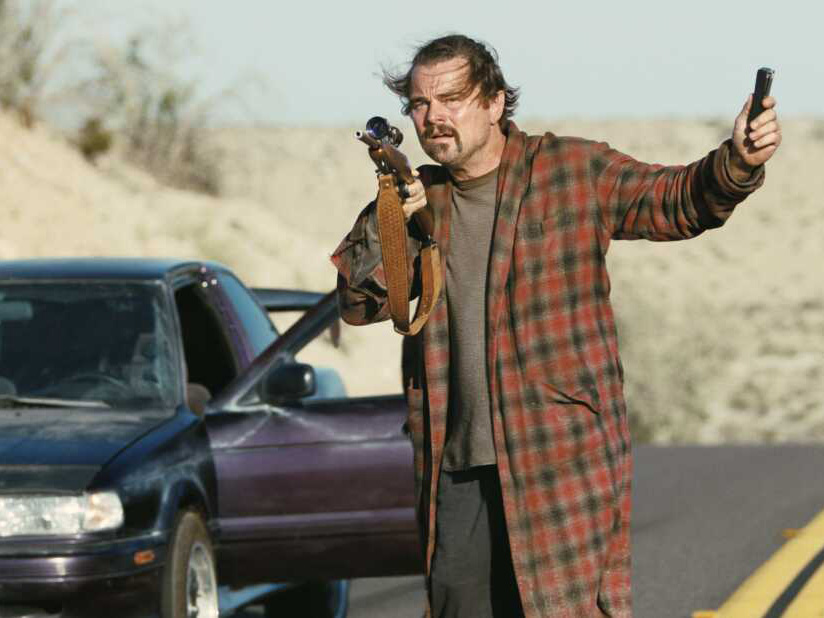
Few movies have garnered as much attention and praise as Paul Thomas Anderson’s “One Battle After Another” (2025). The film offers both a timeless story of the fight for freedom and liberation against repression and tyranny and also a remarkably timely depiction of an alternative, if nightmarish, America that reflects much too closely to our current moment. Watching protestors and police battle in streets of the film’s fictional Baktan Cross, one can’t help but think of similar clashes in places like Fergusson or Minneapolis.
Temporality shapes this film in many ways. The film’s pace fluctuates, sometimes reflective and meditative but often relentless and tense. Cycles of protest, resistance, and counterprotest persist in a seemingly perpetual contest between those factions of society that seek greater equality and justice and those who benefit from an institutionalized status quo that thrives on exploitation and state-sanctioned repression. This is a film of generational struggle. Past choices have lasting consequences on future generations who struggle with conflicts left unresolved from earlier generations. The price of on-going cycles of contentious and extremist politics becomes exhausting and costly for either side, leaving scars that are carried into the future.
Anderson’s film was inspired by Thomas Pinchon’s “Vineland,” a book that also deals with social transformation, idealism, and time as its characters navigate the distance between the turbulent 1960s, when freedom and rebellion clashed with Nixonian “fascist repression,” and 1980 when Reagan wins popular re-election and intensifies the war on drugs begun by Nixon. Like Pinchon’s novel, Anderson’s Southern California is too familiar as his characters clash over issues of identity, rights and equality. The fighters for social justice move under the shadows of a border wall, captured immigrant children play in cages, white Christian Nationalists cultivate influence through the state and a militarized police force invades a “sanctuary city,” officially a sweep of undocumented immigrants and narcotics but really to further more personal ambitions.
Many similar movies focus on the political stakes and issues, but this film’s emotional center is on a family caught up in this struggle. The story is told over two periods separated by 16 years and that makes this more of a personal story of the people caught up in contentious politics. The story begins with “Ghetto” Pat Calhoun (Leonardo DiCaprio) and Perfidia Beverly Hills (Teyana Taylor), lovers and members of French 75, a radical organization engaged in a campaign of terrorist activity seeking to trigger a revolution against an oppressive state. Pursuing them is Steven J. Lockjaw (Sean Penn) a racist, sexist law enforcement officer who is fixated on Perfidia. Their interactions result in a daughter and also clashing identities and motivations. Perfidia, who can’t give up the revolutionary life, is captured and betrays the French 75, which is ruthlessly crushed by Lockjaw. Pat, now committed to fatherhood, and his child escape and slip into hiding with new names. Lockjaw gets prestige and eventual promotion while the survivors of the French 75 slip away to find new ways to continue the struggle. Perfidia seizes an opportunity to escape Lockjaw and disappears into Mexico, wanted by the state and labelled “a rat” by her former colleagues. Sixteen years later, Pat has become Bob, a paranoid stoner recluse hiding in Baktan Cross, a sanctuary city, with his teenage daughter Willa (played wonderfully by Infiniti Chase) who is increasingly disappointed with Bob’s substance abuse and grew up believing her mother was a hero. Lockjaw, now a colonel, is given the chance to join a powerful White Christian nationalist group that promises power and wealth. But first Lockjaw has to bury his past sexual relationship with Perfidia, even if that means disposing of Pat and Willa. Much of the rest of the movie is essentially a chase but like most travel stories, a story of personal change. Willa learns more about her past even as the resistance tries to spirit her to safety. Bob tries to overcome his own failings as a parent and become the father he wants to be for his daughter. Lockjaw utilizes his power to try to capture and perhaps sacrifice his daughter to fulfill his own personal ambitions. Time figures prominently within this family as an older generation comes to terms with its failings and the new generation perhaps finds some meaning, inspiration and hope from the past.
This is a movie steeped in political context but focuses on the characters and their choices. Yet there is much for the political scientist to consider. Radical terrorist violence rarely triggers broader revolution and is subject to state repression, but cycles of contentious politics continue and evolve, taking new forms. Extremist violence gives way to street protests and new social organizations that engage a broader community. Leadership matters. Benecio Del Toro gives a pivotal performance as Sensei Sergio, who runs both a martial arts school and has a “little Harriet Tubman thing going” that funnels undocumented immigrants through Baktan Cross. Sergio’s cool competence, focus, and leadership allow him to utilize his social organization to safeguard the immigrants he’s protecting, rescue Bob and help him reconnect with his daughter. Past revolutionaries become legendary for future leaders and even former members play critical roles helping those in this new generation of resistance. Ideology features in the film but the politics is really about identity, be it race, nationality or sexuality, and allegiances are the basis of collective efforts. In such a world, contentious politics often become polarized, a world of “us vs them” and less a dialogue about common and shared ideas. Resistance against a powerful security state is a game of subterfuge, maneuver, and intelligence gathering. The resistance plays hide and seek or be crushed by the power of the state. Danger exists when a securitized state with highly militarized police is willing to do business with more extreme paramilitaries and economically powerful factions with their own ambitions and interests. In this America, the state uses its monopoly of violence to repress “an enemy within,” the rest of us, with little accountability or constraint.
In this alternative America, there is much that looks familiar, and it offers a haunting vision of what America, where civil rights and democracy have been supplanted by unaccountable repression, could become if we let it. As Bob reminds us, "Freedom is a funny thing, isn't it? When you have it, you don't appreciate it, and when you miss it, it's gone." The film ends with a hopeful note as the generations reconcile and the struggle to build a better America is passed on to another generation. But the film also offers us a warning about the need to protect the democracy we have, for it is that democracy that protects our freedoms but which, like all valuable things, is lost when taken for granted. Early in the film, Bob, the radical, suggests that to build a better world requires fighting one battle after another. Later, Lockjaw reflects that his struggle as an agent of state repression is really about dealing with one problem after another. The cycle of contention continues and yet, in democracy, we all have a role to play in making a better world for us all.
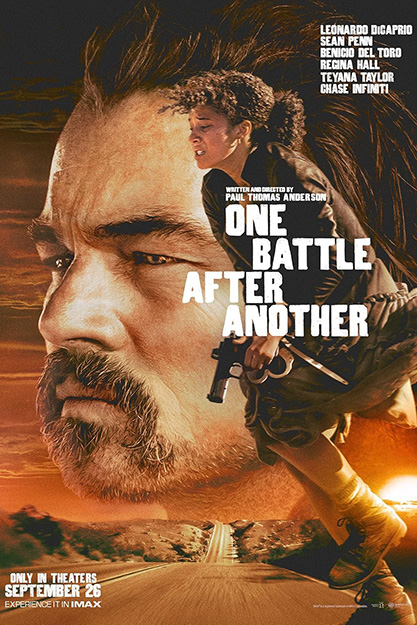 Stars? Four and ½ out of 5. Why? A few reasons. Again, for a political movie, the politics is mostly backstory and while the characters and plot might be seen as metaphor and symbolic, the truth is that there are other films that have addressed the life of insurgents, radicalization and the costs of resistance and the repressive capacity of the state better than One Battle After Another. This is a mostly a chase movie with a political context but it resists dealing with the underlying politics in a more meaningful way. The depictions of women, and especially African-American women become, at times, highly sexualized and fetishized by both the male characters and the films narrative lens. Even if interracial relationships are central to the plot, the primary focus of the film is on the actions of DiCaprio’s Pat/Bob and Penn’s Lockjaw. While Penn’s performance is wonderfully villainous as DiCaprio’s is frequently comic, this film’s focus on these characters comes at the loss of more interesting stories told by the other members of the cast. I would have liked to have seen more of Teyana Taylor, Infiniti Chase, and Benecio Del Toro and the complexity of these characters is lost, perhaps in order to maintain the pacing of the film. The result becomes almost a comic book of stereotypes and less real people. This film will please some but can insult and disappoint others, in part because, perhaps, it could have been better. Visually appealing, often funny and entertaining, the film has set pieces that are wonderfully done. It is often a roller coaster thanks to the pace but it would have been a more enjoyable ride had more time been devoted to the development of many of its central characters.
– John L. Froitzheim, Ph.D., assistant professor in the Department of Political Science, College of Humanities and Sciences